
Does Automation Reduce Administrative Work in Recovery Centers?
Automation can significantly reduce administrative burdens in recovery centers, allowing staff to focus more on patient care. Key improvements include:
- Time Savings: Automation handles repetitive tasks like scheduling, billing, and documentation, freeing staff to spend more time with clients.
- Improved Accuracy: Automated systems reduce errors in billing and documentation, ensuring compliance with healthcare regulations.
- Cost Efficiency: By cutting administrative costs, centers can allocate more resources to treatment and care.
- Enhanced Patient Outcomes: Streamlined processes lead to better treatment initiation and retention rates.
For example, Denver Health saw a 250% increase in treatment initiations after transitioning to a centralized electronic health record system. Similarly, tools like AI-powered chart-auditing and robotic dispensing systems are helping staff prioritize client care over paperwork.
Automation is no longer a question of "if" but "how." Implementing solutions like Recovery Center CRM can transform workflows, improve data management, and support better recovery outcomes.
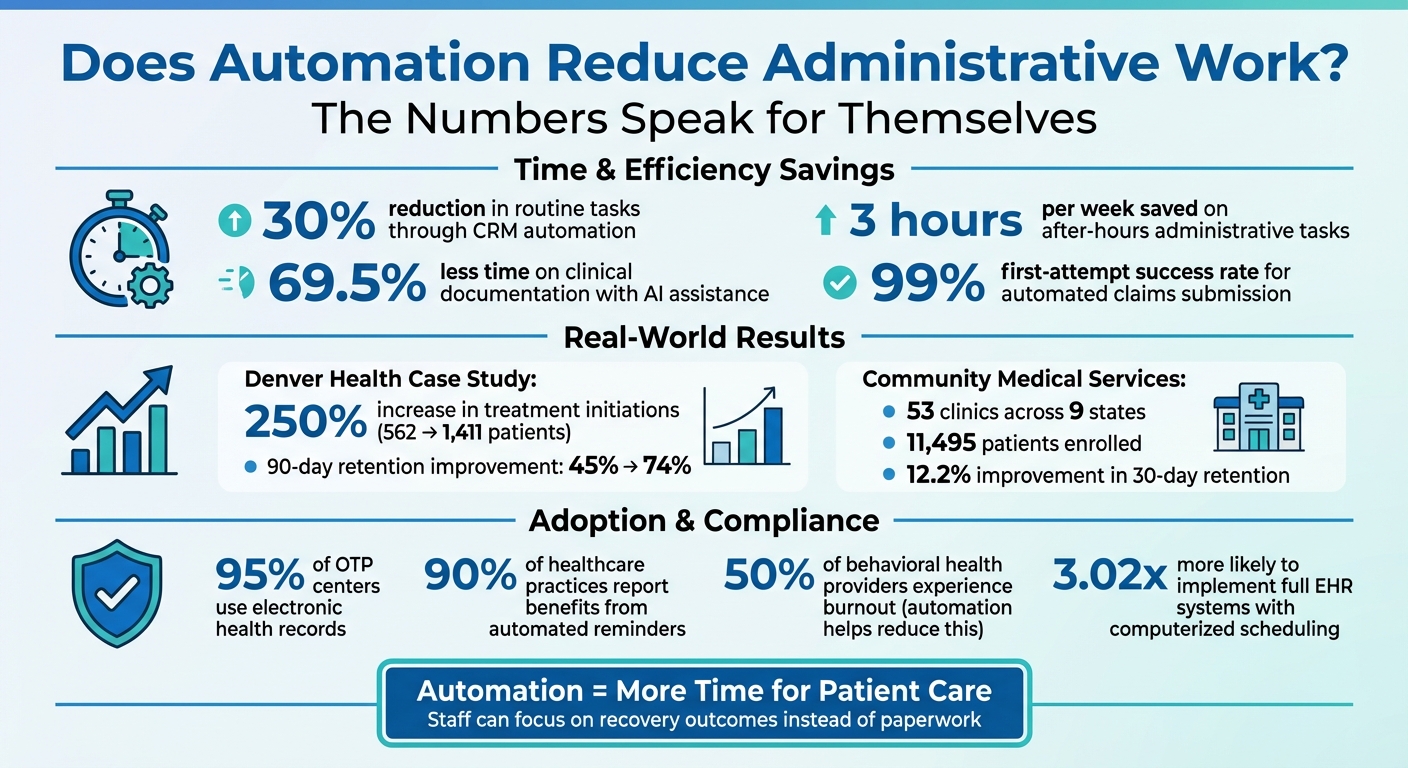
How Automation Reduces Administrative Work in Recovery Centers: Key Statistics and Benefits
How Automation Reduces Administrative Work
Administrative tasks like scheduling, billing, documentation, and reporting can eat up a lot of time in recovery centers. Automation addresses these challenges head-on, streamlining processes and delivering noticeable improvements. Here's a closer look at how automation transforms these essential tasks.
Automated Scheduling and Follow-Ups
Scheduling by hand often slows things down, with staff spending hours calling clients and managing no-shows. Automation simplifies this process with tools like automated text reminders, allowing clients to confirm or cancel appointments instantly. These updates happen in real time, keeping the system accurate and efficient. Automation also matches patients to providers based on treatment needs, insurance, gender, or age, while pre-verifying eligibility to catch potential issues early. Research shows recovery programs with computerized scheduling systems are 3.02 times more likely to implement full Electronic Health Record (EHR) systems.
"A highly visual scheduler really should provide a minute-to-minute encapsulation of everything that's going on at any time throughout the facility while minimizing, if not eliminating, bottlenecks." – ADSC
Streamlined scheduling sets the stage for equally efficient billing and claims processing.
Faster Billing and Claims Processing
Billing becomes much smoother with automation. HCFA and UB claims can be submitted with nearly a 99% success rate on the first attempt. Automated systems also forward claims from primary to secondary payers without manual intervention. Denial management tools help staff quickly address and resubmit rejected claims, while Electronic Remittance Advice (ERA) reconciliation matches payments to claims effortlessly. Together, these features significantly cut down on the time and effort spent on billing.
Centralized Documentation and Workflow Management
Automation also simplifies documentation by centralizing everything in one platform. Instead of dealing with paper forms or scattered spreadsheets, clients can register through self-service kiosks or online portals, with their data automatically integrated into the system. For example, when a counselor signs a clinical note, the software can instantly generate the corresponding billing code. Templates built into the system guide staff through intake forms, evaluations, and group therapy notes. Additionally, live scheduling views enhance resource and staff coordination, reducing inefficiencies.
Automated Reporting and Compliance Monitoring
Manually preparing reports for compliance or tracking clinical outcomes and financial performance can be a huge time drain. Automated systems generate real-time reports based on preset parameters, taking much of the manual labor out of the equation. Compliance with regulations like HIPAA and SOC 2 is built into the workflow, thanks to features like data encryption and role-based access controls. This not only reduces the risk of violations but also supports public health efforts with accurate, timely data. By automating these processes, staff can shift their focus from paperwork to providing direct care for clients.
Key Features of Recovery Center CRM by Bee Purple
Recovery Center CRM by Bee Purple is designed to simplify operations for recovery centers, combining tools for intake management, analytics, and secure communication into a single system. This is particularly valuable as about 50% of behavioral health providers experience burnout, often due to overwhelming documentation and administrative tasks.
Automated Intake and Data Management
This platform serves as a centralized hub for all client-related data - demographics, interaction history, referrals, and recovery milestones. With everything in one place, staff can instantly access complete client profiles without switching between systems. The system also allows for customization, including tailored fields, forms, and workflows, making it adaptable to specific needs like managing court-ordered referrals or voluntary admissions.
Recovery progress is automatically tracked, with the platform documenting assessments, health barriers, and milestones over time. It even prioritizes follow-up actions by analyzing external data, such as daily EMS reports, to ensure high-need individuals get immediate attention. Justin, a user of Recovery Center CRM, shares his experience:
Using this platform, I have the complete profile of a person in recovery with all of our interactions in one place. The amount of time this saves us internally on streamlining administrative processes is huge.
Impact Reporting and Analytics
Customizable reports make it easy to track key metrics like admissions, occupancy rates, and long-term outcomes, providing measurable insights for funders and stakeholders. Operational data - such as staff-to-patient ratios and facility usage - can also be monitored, allowing administrators to allocate resources more effectively.
The system’s predictive analytics identify early signs of relapse, enabling proactive intervention before issues escalate. Additionally, administrators can analyze demographic trends and treatment outcomes to refine strategies and update policies based on real-world data rather than assumptions. These analytics integrate seamlessly with automated communication tools, further improving efficiency.
HIPAA-Compliant Communication and Outreach
The platform automates communication workflows, including appointment reminders, follow-up messages, and alumni outreach, all while adhering to strict HIPAA and SOC 2 compliance standards. Secure portals enable clients to access schedules, message therapists, and complete assessments. Follow-ups are automatically scheduled at intervals like 30, 90, or 365 days post-discharge to maintain engagement and reduce relapse risks.
Nearly 90% of healthcare practices using automated reminders report benefits like reduced no-show rates. The CRM also supports telehealth, enabling virtual counseling sessions, and includes e-consent tools with digital signatures for managing sensitive information. For centers dealing with substance use disorder cases, the system meets both HIPAA and 42 CFR Part 2 standards, ensuring additional protections for patient identity. By streamlining communication, staff can focus more on meaningful client interactions.
Benefits of Automation in Recovery Centers
More Time for Staff and Client Care
Automation takes over repetitive tasks, freeing up staff to focus more on clients. For instance, CRM automation can cut down routine tasks by up to 30%. Even more impressive, AI-assisted documentation slashes the time spent on clinical documentation by 69.5%. Primary care providers using automation tools have also reported saving 3 hours per week on after-hours administrative tasks.
These time savings don’t just help with workload - they also improve data accuracy and ensure compliance with regulations.
Better Data Accuracy and Compliance
Automation does more than save time; it ensures consistent, error-free data across all processes. Manual data entry often leads to mistakes, but automation eliminates this risk by standardizing treatment episode definitions across programs. A unified platform integrating EMR, CRM, and revenue cycle management allows seamless data flow from intake to billing, reducing the need for manual re-entry and cutting down on errors.
Regulatory changes are also making automation more attractive. Updates to 42 CFR Part 2 now allow federally funded substance use treatment data to be integrated into centralized EHRs. This means better care coordination while staying compliant. Among centers operating opioid treatment programs, 95% use electronic methods to store health records, compared to 85% of those without OTPs.
Scalability for Large Recovery Ecosystems
For recovery centers looking to expand, automation is key to maintaining consistent care across multiple locations. Centralized systems offer real-time insights into patient progress and challenges, making it easier to spot and address high-risk situations promptly.
A great example of this is Community Medical Services, which rolled out the "Recovery Connect" mobile app across 53 clinics in 9 states between July 2023 and June 2024. This initiative involved 11,495 patients and 302 mental health professionals, leading to a 12.2% improvement in 30-day retention across all clinics and a 13.2% improvement in Arizona-based clinics. By integrating real-time communication and self-monitoring tools, they’ve built a solid foundation for data-driven growth.
sbb-itb-ce23a48
How to Implement Automation in Recovery Centers
Identifying High-Impact Areas for Automation
To kick things off, gather insights from your team through structured interviews and focus groups. This helps uncover specific challenges, such as manual processes that eat up time - like reviewing notes or re-entering the same data across multiple spreadsheets.
Focus on tasks that are repetitive and require lots of clicks. These are prime candidates for automation. Before diving in, standardize definitions across your programs. For instance, ensure everyone agrees on what a "treatment episode" means to maintain consistent data.
Take Denver Health as an example. In February 2022, their Center for Addiction Medicine revamped their system by integrating EHRs. They replaced manual processes - like phone calls, emails, and spreadsheets - with a standardized referral order system. The impact? A 250% increase in patients initiating SUD treatment, jumping from 562 to 1,411, and a boost in 90-day retention rates from 45% to 74%.
Once you've pinpointed the tasks to automate, the next step is ensuring your team is ready to adopt the new systems.
Training Staff for System Adoption
One of the biggest barriers to successful implementation is insufficient training, which often leads to low adoption rates in SUD programs. To avoid this, schedule a one-month training period with extra technical support during the first week. Tools like Webex can be invaluable, offering staff real-time assistance when they need it.
Before rolling out new tools, review existing workflows to confirm the changes will actually reduce admin strain. The Office of the National Coordinator for Health Information Technology provides a "Health IT Playbook" with tailored advice for behavioral health settings. Keep the momentum going by holding monthly check-ins to address any technical hiccups and tweak training as necessary.
Once your team is up to speed, the next priority is securing your system and staying compliant.
Maintaining Security and Compliance
Take advantage of the 2020 updates to 42 CFR Part 2, which allow SUD-related information to be shared within your health system for operational purposes. Update your consent protocols accordingly and use data segmentation to ensure that sensitive records are only accessible to authorized staff.
Platforms like Recovery Center CRM by Bee Purple are built with these standards in mind, offering role-based permissions that let agencies share data securely. Maintaining HIPAA and SOC 2 compliance is non-negotiable, so any system you adopt should meet these requirements to safeguard patient confidentiality.
Replace outdated tools like Microsoft Access with EHR-based dashboards that come with stronger security features. Regularly monitor access patterns to ensure compliance across your system and maintain the integrity of your data.
Conclusion
Automation simplifies operations and allows staff to concentrate on what truly matters: providing personalized client care. By centralizing documentation, automating follow-ups, and organizing billing processes, teams can shift their focus away from administrative burdens and toward improving recovery outcomes. The results speak for themselves - Denver Health reported a 250% increase in treatment initiations and better 90-day retention rates thanks to centralized systems.
This approach doesn’t just save time; it also ensures better data accuracy and compliance. Replacing scattered spreadsheets with integrated systems makes reporting more reliable and compliance easier to manage. As Justin, a Bee Purple user, shared:
The amount of time this saves us internally on streamlining administrative processes is huge.
For recovery centers looking to grow their impact, automation is more than a convenience - it's a necessity. Tools like Recovery Center CRM by Bee Purple not only handle repetitive tasks but also uphold HIPAA and SOC 2 compliance standards. They provide real-time analytics, helping stakeholders measure program success while freeing up staff to focus on guiding clients through their recovery journey.
FAQs
How does automation help reduce administrative work and improve care in recovery centers?
Automation is transforming recovery centers by taking over time-intensive administrative tasks, freeing up staff to concentrate on what truly matters - client care. By centralizing documentation, tracking recovery progress, and automating scheduling, it reduces the likelihood of errors and simplifies daily operations. This shift allows staff to spend more time offering personalized support and counseling, which directly boosts the quality of care provided.
On top of that, automated tools deliver critical data insights and progress reports. These help clinicians make smarter decisions, tailor treatment plans, and spot potential issues before they escalate. With tools like electronic health records (EHRs) and AI-powered decision support, automation also improves communication, ensures adherence to privacy regulations, and enables long-term monitoring of client progress. Altogether, these advancements contribute to better outcomes for patients and more efficient recovery programs.
How does Recovery Center CRM help reduce administrative work for recovery centers?
Recovery Center CRM takes the hassle out of administrative tasks, giving staff more time to dedicate to client care. By bringing everything into one place - like documentation, recovery tracking, and demographic profiles - it ensures that essential information is always organized and easy to find.
On top of that, the platform handles scheduling automatically, simplifies communication, and creates detailed progress reports and insights. These tools not only make day-to-day operations smoother but also help deliver tailored care and support lasting recovery outcomes.
How can recovery centers maintain data security and compliance when using automation?
To keep data secure and stay compliant while using automation, recovery centers need to ensure their tools align with strict standards like HIPAA and SOC 2. Tools such as Recovery Center CRM are built with these needs in mind, offering features like centralized documentation, secure communication workflows, and measures to maintain data integrity.
In addition to using secure platforms, recovery centers should establish clear policies for data access, train staff thoroughly on handling sensitive information, and conduct regular audits. Monitoring automated processes is also key to identifying and addressing potential risks. With the right mix of secure technology and well-defined procedures, staff can prioritize client care while safeguarding sensitive data and staying compliant.