

Tracking Recovery Capital: A New Approach to Care
Recovery capital is the mix of personal, social, community, and cultural resources that support recovery from substance use disorders. Unlike traditional methods that focus on symptom reduction, this approach emphasizes building strengths and addressing barriers to long-term success. Measuring recovery capital helps programs tailor care to individual needs, ensuring better outcomes.
Key Points:
- What It Includes: Internal resources (health, skills), social networks (family, peers), community support (housing, jobs), and cultural identity.
- Why It Matters: Recovery is dynamic and takes time - on average, five years to achieve stability. Tracking resources and barriers provides a fuller picture than sobriety metrics alone.
- Tools to Measure It:
- ARC/BARC-10: Focus on personal and social resources.
- MIRC: Tracks both resources and barriers.
- REC-CAP: Adds well-being and visual progress tracking.
Why Programs Should Use It:
By assessing recovery capital, treatment centers can:
- Match care intensity to individual needs.
- Identify and address barriers like unsafe housing or lack of transportation.
- Build sustainable recovery plans with tools and community connections.
This approach shifts the focus from just treating symptoms to empowering individuals with the resources they need for long-term recovery.
8 31 22 Recovery Capital: Measure, Plan, and Engage 20220831 1358 1
The Main Components of Recovery Capital
Breaking down the components of recovery capital helps explain why traditional recovery metrics often miss the mark. Each element plays a distinct role in shaping a well-rounded recovery journey, and their interconnected nature means progress in one area can often boost others. For example, joining a sports league might not only improve physical health but also create new friendships and connect someone to local support resources.
Recovery capital is not static - it evolves. As someone moves forward in recovery, they might gain employment, build healthier relationships, or improve their physical and mental health. However, it can also decrease due to setbacks, life changes, or relapse. This fluidity makes understanding these dimensions even more critical.
Personal Capital
Personal capital refers to the internal resources and basic needs that form the backbone of recovery. This includes physical health, mental well-being, financial security, education, problem-solving abilities, and self-efficacy. These elements are essential for maintaining long-term progress.
A study conducted by Go Forth Recovery, a residential addiction recovery home in South Carolina, tracked the recovery capital of 69 male residents between July 2018 and December 2022. Led by Alexis M. Stoner and her team, the research revealed that graduates of the program (n = 39) made significant strides in personal and physical capital compared to those who didn’t complete the program (n = 30). For instance, the percentage of graduates with a driver’s license jumped from 28.21% at intake to 82.05% at completion, while health insurance coverage rose from 5.13% to 74.36%. Non-graduates, on the other hand, showed little improvement in these areas, underscoring how tangible personal resources are closely tied to treatment success.
Personal capital also includes less tangible qualities like resilience, self-esteem, and a sense of purpose. These traits help individuals navigate obstacles, make better decisions, and stay motivated, even during tough times. Without a solid foundation of personal capital - whether it’s stable housing, a steady income, or self-confidence - clinical treatments alone may not lead to lasting recovery. These personal gains are critical as they connect to broader social and community support systems.
Social and Family Connections
Social capital focuses on the network of relationships that provide emotional support, accountability, and a sense of belonging. This network may include family, friends, partners, and peer groups like Alcoholics Anonymous (AA), Narcotics Anonymous (NA), or SMART Recovery. Positive family involvement can significantly improve recovery outcomes, while relationships with individuals still struggling with addiction may act as negative influences, hindering progress.
Peer support groups offer a unique benefit by fostering a "recovery-oriented identity." This shift in self-perception is a strong indicator of long-term recovery success. Tools like social identity mapping (SIM) can help individuals visualize their social networks, identifying which relationships support their recovery and which pose risks. This process highlights the importance of building and maintaining connections that reinforce recovery.
Community and Cultural Resources
Community capital refers to the external resources available in someone’s environment. These resources might include recovery housing, drug courts, specialized treatment programs, educational opportunities, vocational training, and employment services. Together, they provide the infrastructure needed to reintegrate into society and build a meaningful life beyond substance use.
Cultural capital, often overlooked, also plays a key role. It includes elements like cultural values, faith traditions, rituals, and community practices that support recovery. For many, spiritual practices or a strong connection to their cultural identity can provide a sense of purpose and belonging, reinforcing their commitment to recovery. Incorporating these elements can strengthen support systems for individuals from diverse backgrounds.
"A program that's plugged into resources for food, housing, medical care, mental health care, educational and training programs, recreation and arts programs, and spiritual and cultural program is better equipped to serve the needs of its clients than one that stays in its silo and only focuses on substance use." – Debbie Shepard, LCSW, RDDP, JD
The combination of community and cultural resources creates a broad support system that goes beyond clinical treatment. Access to these resources can be the deciding factor in whether someone sustains recovery or returns to substance use, especially during the critical five-year period it often takes to achieve stability.
How to Measure Recovery Capital: Tools and Methods
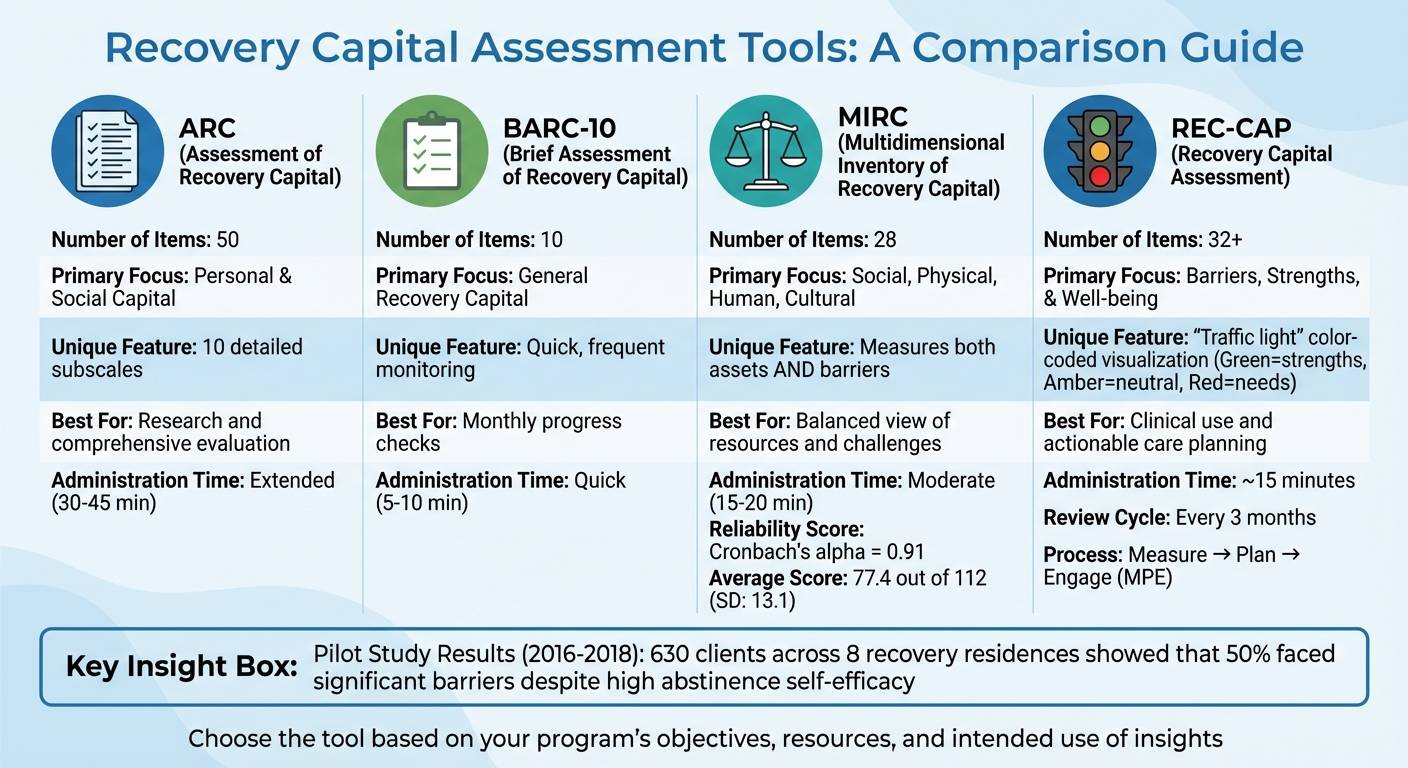
Recovery Capital Assessment Tools Comparison: ARC, BARC-10, MIRC, and REC-CAP
Effectively measuring recovery capital is crucial for creating recovery programs tailored to individual needs. This process involves tools that assess both an individual's resources and the challenges they face. Over the past two decades, various validated tools have been developed, moving beyond traditional deficit-focused evaluations to highlight what individuals can build upon.
These tools vary in complexity and speed, so selecting the right one depends on your program’s goals and how you intend to use the results. Below, we explore some of the most widely used methods.
Assessment of Recovery Capital (ARC) and Brief ARC (BARC-10)
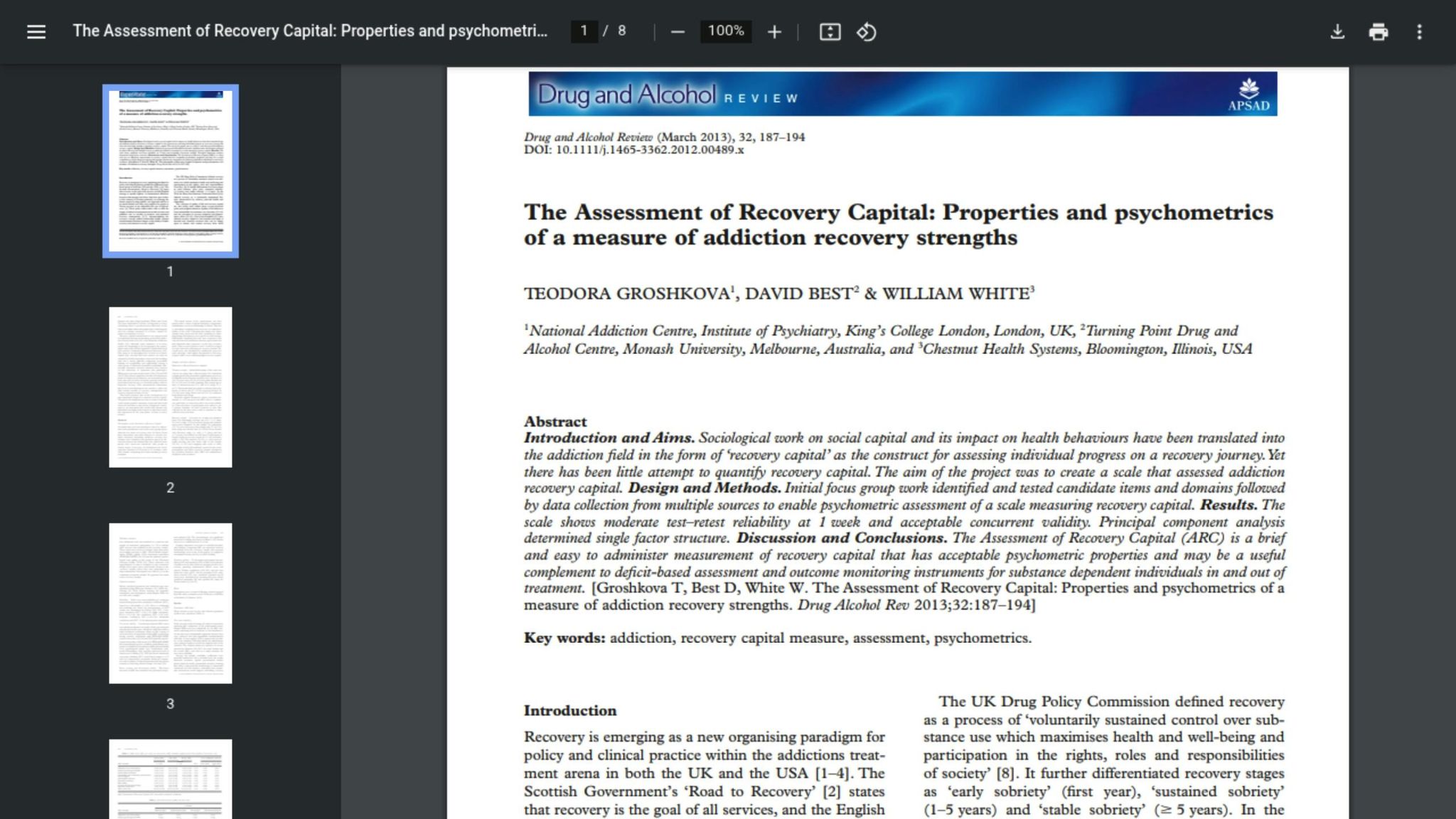
The Assessment of Recovery Capital (ARC) is a 50-item scale that evaluates two main areas: personal and social recovery capital. Each area is further divided into five subscales, providing a detailed overview of an individual’s recovery resources. While the ARC is widely recognized in research, its length and complexity have limited its use in clinical settings.
To address this, the Brief Assessment of Recovery Capital (BARC-10) was developed. This streamlined version condenses the assessment to just 10 items, making it ideal for quick evaluations and frequent monitoring, such as monthly progress checks. The BARC-10 focuses on identifying and tracking recovery resources over time without the administrative burden of the full ARC.
Both tools emphasize identifying strengths rather than focusing solely on deficits. However, they primarily assess what an individual has, leaving gaps in understanding the obstacles they face. This is where tools like the MIRC offer a more comprehensive perspective.
Multidimensional Inventory of Recovery Capital (MIRC)
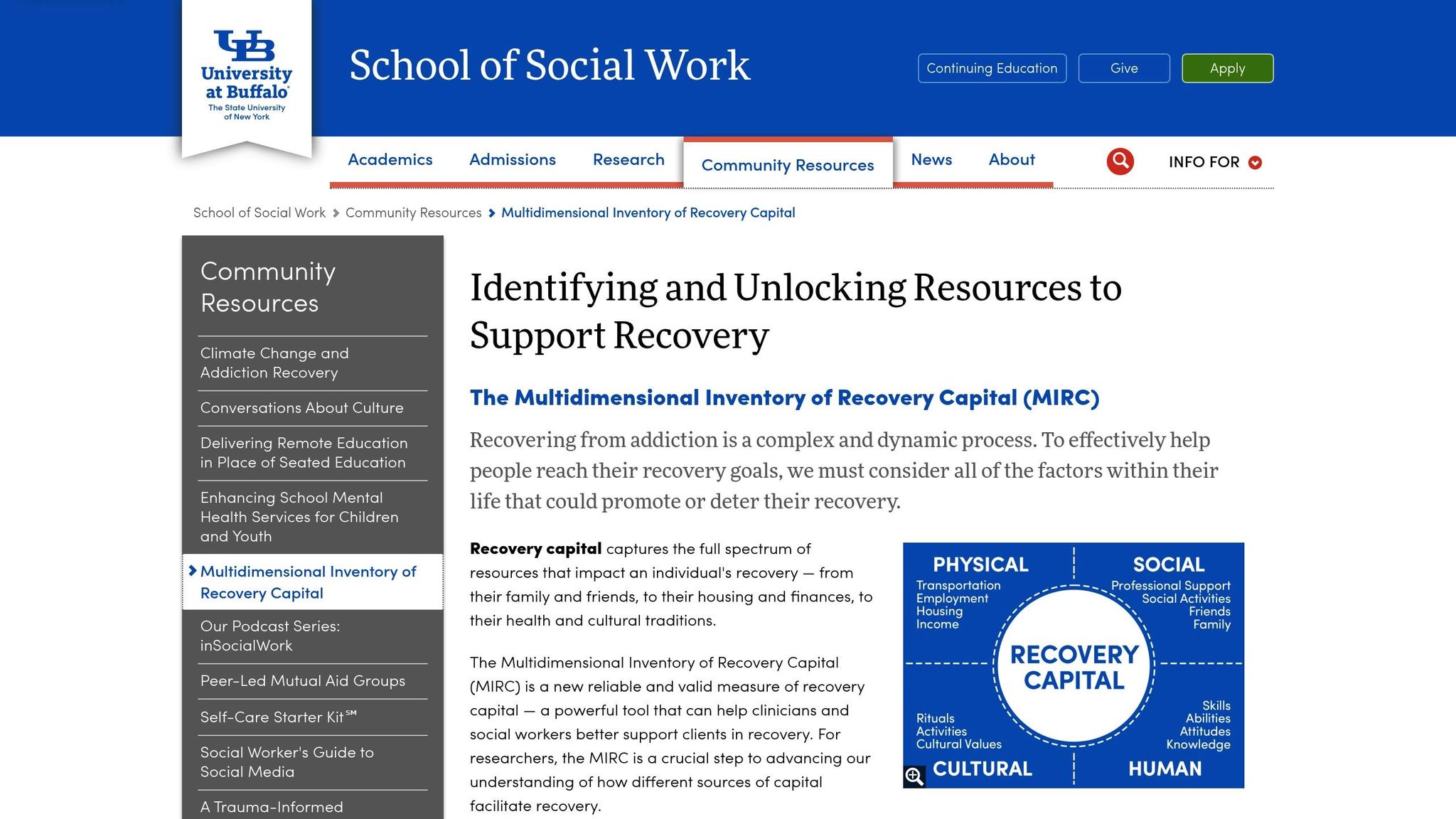
The Multidimensional Inventory of Recovery Capital (MIRC) broadens the scope by evaluating both resources and barriers across four categories: social, physical, human, and cultural. This 28-item tool captures a balanced view of positive and negative factors affecting recovery.
In its development study, the MIRC scored an average of 77.4 out of 112, with a standard deviation of 13.1, and demonstrated strong reliability with a Cronbach’s alpha of 0.91. Unlike tools that focus solely on assets, the MIRC also highlights barriers, such as unsupportive family members, unsafe housing, or transportation challenges.
"The MIRC is not an indicator of who will 'succeed' in recovery. It is a way of looking at the resources you have to support your recovery (positive capital) and the things in your life that might make recovery more challenging (negative capital)." – University at Buffalo School of Social Work
This dual focus makes the MIRC particularly useful for self-reflection and targeted intervention planning. It helps individuals and clinicians work not only on building resources but also on reducing negative influences, leading to more effective care strategies.
REC-CAP Recovery Capital Assessment
The REC-CAP builds on the ARC by integrating recovery capital assessments with evaluations of barriers, well-being, and social support. Designed for clinical use, the REC-CAP takes about 15 minutes to complete and is typically used on a three-month review cycle.
What sets the REC-CAP apart is its "traffic light" visualization system. Results are color-coded - green for strengths, amber for neutral areas, and red for needs - making it easy for clinicians and clients to see where they stand in their recovery journey. This visual approach turns assessment data into actionable recovery maps.
Between 2016 and 2018, the Florida Association of Recovery Residences (FARR) partnered with Sheffield Hallam University to implement the REC-CAP across eight recovery residences. This project involved 630 clients and revealed that while many showed high abstinence self-efficacy, 50% faced significant barriers like unmet health needs or a lack of meaningful activities. These insights allowed care teams to move from static assessments to dynamic, individualized recovery planning.
"The REC-CAP is both an innovative assessment tool and a method of creating and operationalizing an evidence-based recovery care planning and review process with direct links to community engagement." – ARCC
The REC-CAP follows a three-step Measure, Plan, Engage (MPE) process. First, it identifies both resources and barriers. Second, it creates a strengths-based care plan. Third, it connects individuals to supportive community activities. In a pilot study of 100 cases, half of the participants reported at least one barrier, with an average of two barriers per person.
| Tool | Items | Primary Focus | Unique Feature |
|---|---|---|---|
| ARC | 50 | Personal & Social Capital | 10 detailed subscales |
| BARC-10 | 10 | General Recovery Capital | Quick, frequent monitoring |
| MIRC | 28 | Social, Physical, Human, Cultural | Measures assets and barriers |
| REC-CAP | ~32+ | Barriers, Strengths, & Well-being | "Traffic light" visualization |
Each tool serves a specific purpose. The ARC provides detailed research data, the BARC-10 offers quick snapshots, the MIRC balances assets and barriers, and the REC-CAP translates assessments into actionable care plans. Choosing the right tool depends on your program’s objectives, available resources, and how you plan to use the insights to support long-term recovery.
sbb-itb-ce23a48
Using Recovery Capital in Treatment Centers
Recovery capital assessments are transforming how treatment centers approach care. By focusing on individual strengths and barriers - not just the severity of substance use - centers can better match treatment plans to each person's unique situation.
Matching Care Intensity to Recovery Capital Levels
Recovery capital assessments offer a deeper understanding of a person's needs compared to severity-based methods alone. For instance, someone with severe substance use but strong family support, stable housing, and reliable transportation might thrive with less intensive care. On the other hand, a person with mild substance use but no housing, transportation, or social support may require substantial resources to achieve stability.
This approach uses a recovery capital and severity matrix to allocate resources more effectively. Between 2016 and 2018, a pilot program with 630 clients demonstrated how tailoring care based on recovery capital can improve outcomes. For example, Angela, in early recovery from methamphetamine use, had housing as her only strength. Her care plan prioritized immediate stabilization and health concerns before focusing on community engagement. Meanwhile, JoAnne, with a 20-year history of substance use but high recovery capital, worked on achieving long-term goals like finishing nursing school.
"The assessment of internal and external assets to support recovery maintenance has major clinical import... [including] determining level of care placement [and] formulating counseling strategies." – David Best, Professor of Criminology
This framework shows that a person with stable housing and good health might not need extended residential care, even if their substance use is severe. Conversely, someone with minimal clinical severity but lacking basic resources often requires intensive support to build recovery capital. By applying these insights, treatment centers can improve outcomes by actively increasing recovery capital through targeted interventions.
Building Recovery Capital Through Recovery Programs
Once care intensity is aligned with recovery capital levels, the next step is to systematically increase these resources. This involves a structured Measure, Plan, Engage (MPE) process.
- Measure: Identify barriers such as unemployment, unsafe housing, or lack of transportation, alongside existing strengths like family support or resilience.
- Plan: Set specific, actionable goals rather than vague objectives.
- Engage: Connect clients to resources like sober housing, peer support groups, vocational training, or faith-based communities.
Peer navigators, individuals with lived recovery experience, are central to this process. They mentor clients, helping them execute goals and track progress using visual tools like "traffic light" maps - red for barriers, green for strengths.
"Substance use treatment programs are most successful when they involve themselves in the community and with the families of their clients." – Debbie Shepard, LCSW
Recovery is rarely a one-time event. Studies show most clients need 3 to 4 episodes of care before achieving stable abstinence, with relapse risks remaining high until 4 to 5 years of sustained recovery. This makes recovery capital building an ongoing process, requiring regular monitoring and adjustments as clients transition from structured treatment to self-directed recovery.
Using Technology for Recovery Capital Tracking
Technology is revolutionizing how treatment centers track and manage recovery capital over the long term. Manual tracking is time-consuming and prone to delays, but digital platforms streamline the process, making recovery capital assessments scalable.
Platforms like Recovery Center CRM (https://beepurple.com) provide a centralized system for documenting and tracking outcomes over the 4 to 5 years typically needed to reach stable abstinence. These tools automate care plan creation, using identified strengths and barriers to guide interventions and provide real-time feedback to clinicians.
For state-wide initiatives, aggregate dashboards allow treatment centers to evaluate outcomes across teams or regions, highlighting successful programs and identifying systemic challenges. This is especially useful for State Departments of Health and justice system partners who need to demonstrate the effectiveness of public funding in compliance with federal grant requirements.
The platform also ensures data integrity, HIPAA and SOC 2 compliance, and consistent client outreach during high-risk transition periods. Automated workflows help maintain contact with clients, reducing the risk of relapse. Regular reassessments - quarterly or monthly - track changes in recovery capital, ensuring new barriers are addressed promptly. For treatment centers managing hundreds of clients, this level of monitoring would be unmanageable without automation.
Conclusion: Moving Forward with Recovery Capital
Shifting the focus from deficits to recovery capital marks a major change in how treatment centers approach long-term care. Instead of zeroing in on symptoms, this framework prioritizes building both internal and external resources. The numbers speak for themselves: individuals with higher recovery capital experience three times lower relapse rates and report 50% greater life satisfaction compared to those with fewer resources. This shift highlights why recovery capital is becoming central to personalized care.
"Recovery capital is now the emerging international construct for the addiction field. It can translate across the various spheres of addiction influence and delivery. It is the way forward." – David Best
This model allows recovery professionals to tailor care plans based on a client’s unique resource levels. For instance, someone with stable housing, dependable transportation, and strong family support might do well with less intensive care. On the other hand, a client without these essentials may need more robust support systems. By monitoring recovery capital over time, professionals can proactively address potential barriers before they escalate into relapse.
Long-term recovery isn’t a one-and-done process - it requires a multi-year, multi-episode approach, making regular tracking of resources crucial. Tools like Recovery Center CRM (https://beepurple.com) play a key role by centralizing documentation, automating reassessments, and providing real-time insights. These platforms help maintain data accuracy, ensure HIPAA compliance, and support consistent outreach during high-risk transitions, keeping clients supported at every stage of their journey.
FAQs
What is recovery capital and why does it matter in addiction recovery?
Recovery capital refers to the mix of personal, social, and material resources that people draw upon to achieve and sustain recovery from substance use disorders. These resources can include individual strengths, supportive relationships, community engagement, and essential needs like stable housing and employment.
This concept is important because recovery isn’t just about quitting substance use - it’s about creating a stable, meaningful, and fulfilling life. Measuring recovery capital helps care providers pinpoint both strengths and areas where support is needed. This allows for more focused interventions that encourage long-term success by promoting empowerment, building connections, and supporting lasting recovery.
What are the differences between ARC, BARC-10, MIRC, and REC-CAP for assessing recovery capital?
Each of these tools - ARC, BARC-10, MIRC, and REC-CAP - brings a distinct approach to evaluating recovery capital, tailored to different needs and levels of detail.
REC-CAP, developed by Dr. David Best, is designed for use in both clinical and peer-based settings. It focuses on tracking recovery capital over time, highlighting strengths, identifying barriers, and addressing unmet needs. This makes it especially useful for creating personalized, ongoing recovery plans.
BARC-10 is a shorter, validated questionnaire that delivers a quick overview of recovery progress. It emphasizes key areas like social support and personal responsibility, making it an efficient tool for those seeking a snapshot of their recovery journey.
MIRC (Multidimensional Inventory of Recovery Capital) takes a more expansive approach. It assesses multiple domains - such as physical, social, human, and even cultural capital - offering a broader and more detailed evaluation of recovery resources.
Choosing the right tool depends on your specific goals. If you're looking for long-term tracking, REC-CAP is ideal. For a quick and focused evaluation, BARC-10 works well. And if you need a comprehensive, multidimensional assessment, MIRC is the way to go.
How do recovery capital assessments help treatment centers improve care outcomes?
Recovery capital assessments give treatment centers a broader perspective on the resources individuals rely on to maintain their recovery. These resources include social connections, physical health, skills and education, and community involvement - all essential for achieving lasting recovery.
By assessing these areas, providers can pinpoint an individual’s strengths and areas where support is needed. This allows for more targeted interventions and smarter resource allocation. Plus, tracking recovery capital over time lets centers monitor progress, refine care plans, and ensure ongoing support. Tools like Recovery Center CRM make this process easier by organizing data, tracking outcomes, and offering insights that help deliver more tailored care.